

Blueprinting the Future of AI Education
Building upon the foundation of the Digital Learning Enhancement Plan (2022–2025), the Ministry of Education (MOE) has launched the AI Talents Ark Project (2026–2029), marking a transition from digital learning to integration of artificial intelligence (AI) into education. The project is driven by two core objectives: empowering Grade 1-12 teachers with professional AI-integrated teaching competencies and enhancing AI literacy and learning outcomes for students.
Guided by the Taiwan AI Competency Framework for Teachers and Students, the project provides support across six dimensions: digital content, AI learning system, teaching guidance, AI literacy, pre-service teacher education, and big data analysis. These efforts ensure that AI is naturally integrated into modern classrooms.

Taiwan AI Competency Framework for Teachers and Students
Aligned with trends from UNESCO and the OECD, the Framework is localized for Taiwan to guide AI competency with a human-centered mindset. It covers AI ethics, fundamentals, empowered instruction, teacher professional growth, and student learning system design. Through human-AI collaboration, it fosters independent judgment, critical thinking, responsible use, and innovative practice among users.
 Download and read the framework here.

Constructing AI Learning Environments
To refine the digital learning foundation, local governments manage network and device upgrades, while the MOE funds operations and software procurement. By developing digital content and AI learning systems, the program builds a comprehensive smart learning support environment that fosters students' self-regulated learning (SRL) and empowers teachers to deliver personalized and adaptive education at scale.
Digital Content Enrichment
The MOE has worked with the public and private sectors to build a comprehensive system of digital learning resources. They cover core school subjects, vocational education, competency-based learning, and cross-curricular issues (energy, disaster prevention, environmental education, etc.). The materials are available in multiple formats, including videos, e-books, VR/AR resources, interactive modules, gamified learning activities, along with TALPer, a generative-AI learning companion. All resources are integrated into the Taiwan Adaptive Learning Platform (TALP), a one-stop hub that provides teachers and students with access to high-quality digital learning content.

Taiwan Adaptive Learning Platform (TALP)
The Taiwan Adaptive Learning Platform (TALP) is the MOE’s national digital learning platform, offering a wide range of learning resources for classroom teaching and self-regulated learning. The platform incorporates classroom engagement tools and diagnostic assessments to help teachers better understand students’ learning needs. AI-powered feedback and guidance provide personalized learning support, enabling students to strengthen areas where they need improvement.

Knowledge Structure-Based Learning
As a key feature, TALP organizes knowledge into node graphs following the Curriculum Guidelines of 12-year Basic Education. Content is transformed into nodes connected by prerequisite relationships to provide clear learning pathways, with mastery levels indicated by node colors. The system integrates AI diagnosis and high-quality resources to analyze performance and provide individualized remedial advice, helping teachers support differentiated learning.

TALPer: A Generative-AI Companion
TALP features TALPer, an AI-powered learning companion supporting over 850,000 users since September 2024. Using Socratic questioning, dynamic assessment, and multiple strategies, it provides learning scaffolding to guide students' thinking. TALPer includes two types: G-TALPer and S-TALPer.
 Introduction Clips of TALPer
G-TALPer, the domain-general companion embedded in the platform, supports various scenarios, including inquiry, writing, and self-regulated learning. Through interactive conversations, students actively build knowledge, enhancing learning efficiency and comprehension.

S-TALPer, the domain-specific TALPer, is connected to TALP's knowledge structure. It identifies learning gaps based on performance to provide personalized guidance and recommendations for upward extension or remedial support.

Developing Next-Generation AI Learning System
The Next-Generation AI Learning System Development Program focuses on the development of a series of AI services tailored for distinct roles within the educational ecosystem. By integrating an open educational framework with multimodal learning data, the program utilizes scenario-based AI models to establish a one-stop support system.
The system provides specialized AI support across four primary roles: AI Teaching Assistant (for teachers), AI Learning Tutor (for students), AI Decision Support Assistant (for principals), and AI Helper (for parents). The following diagram details the specific functions and key stages—ranging from classroom instruction and student learning to school governance and parental guidance—where these AI assistants provide support to streamline tasks and enhance the overall effectiveness of the educational ecosystem.

Cultivating Cross-disciplinary AI Teaching Talent
The MOE continues to build a comprehensive teacher professional support and empowerment system, ranging from digital teaching guides and principal/parent support, AI literacy in technical field strengthening, training courses for professional empowerment, and pre-service teacher education.
Guides for Digital Instruction and AI Learning Application Manuals
The MOE has updated the Digital Teaching Guide to the third version, featuring content on AI application in class preparation, teaching, and evaluation. It helps teachers better utilize AI technology in class. The Digital Learning Leadership Guide and the Parent Digital Learning Guide assist school principals in shaping digital visions and empower parents to actively participate in their children's digital journeys.
Furthermore, stage-specific Generative AI Learning Application Manuals have been released for elementary and high school students. They focus on fundamentals, real-world applications, and practical skills—such as prompt engineering and data verification—to foster responsible digital citizenship in the AI era.


Strengthening AI Literacy in Technical Field Program
The Strengthening AI Literacy in Technical Field Program develops Grade 1-12 curriculum guidelines and resources rooted in a human-centered philosophy. Aligned with the Taiwan AI Competency Framework and UNESCO/OECD guidelines, the program utilizes project-based learning alongside problem-based, scenario-driven, and practice-and-reflection models. Through human-AI collaboration, students master future-ready competencies, including critical thinking, responsible AI use, and self-regulated learning.
To ensure scalability and replicability, instructional models undergo iterative refinement through pilot school experiments. The program also provides dual-track teacher training in foundational and practical AI applications, empowering teachers of the technical field to design AI-integrated tasks and to guide student learning. By integrating TALP learning analytics with multidimensional assessment tools, the program establishes an evidence-based evaluation mechanism to optimize national strategies for promoting AI literacy and other educational policies.
Empowerment Courses: Digital Teaching Training Framework
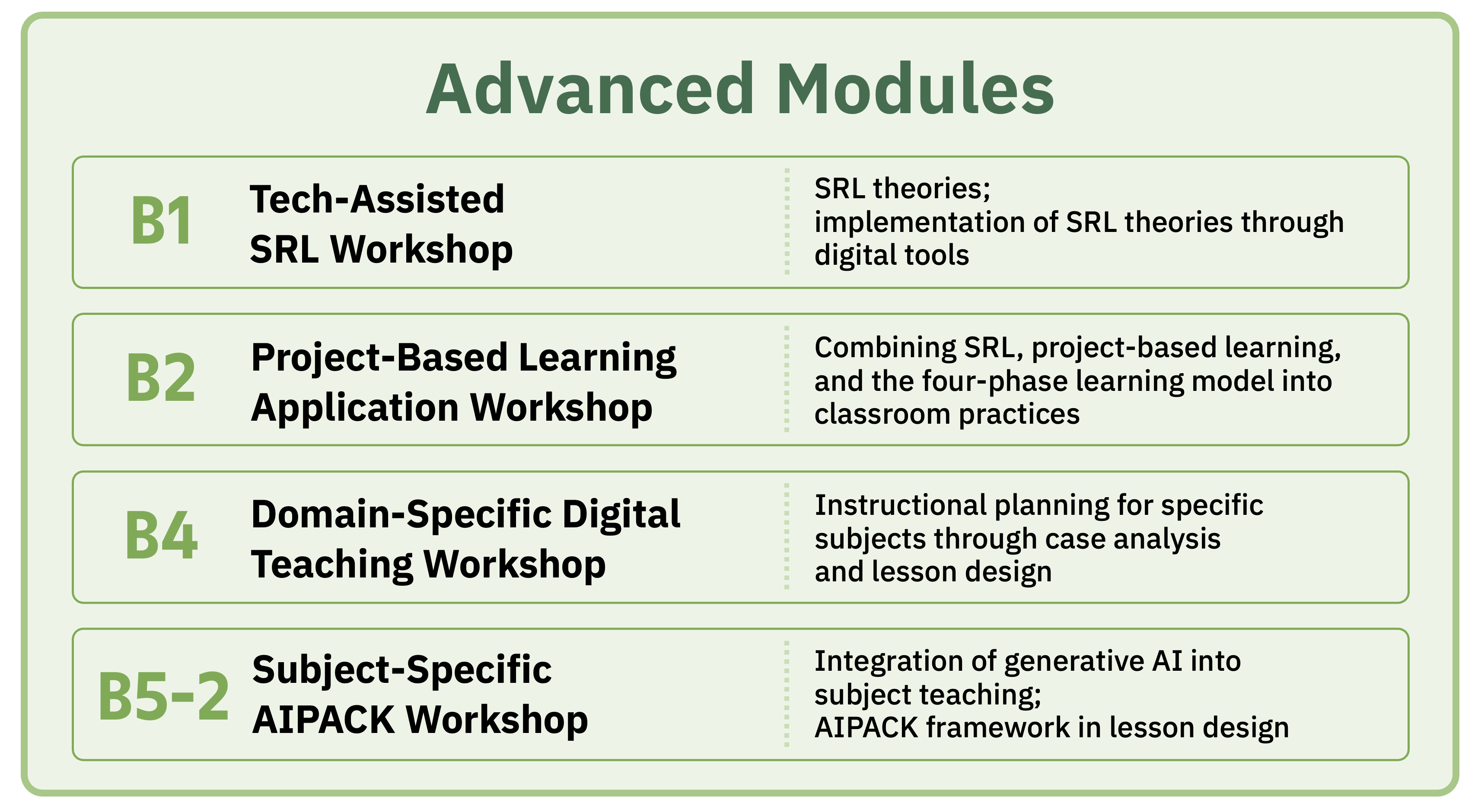
The MOE has developed a framework consisting of courses for professional empowerment, encouraging educators to utilize the latest digital tools and incorporating AI into their teaching practice. The courses are organized into two categories: foundational modules and advanced modules.
- Foundational modules: Establishing essential competencies in digital instruction, platform operations, and digital literacy, while introducing the foundational uses of generative AI in education.
- Advanced modules: Deepening subject-specific expertise through strategies such as self-regulated learning (SRL) and project-based learning. A key emphasis is placed on integrating generative AI into various disciplines using the AIPACK framework.

Teacher Education Alliance for AIED
The MOE has established the Teacher Education Alliance for AIED (AI in Education), aiming to strengthen the abilities of teacher educators and pre-service teachers in applying AI to curriculum design, instructional implementation, and learning support. Led by a coordinating unit, this alliance integrates five specialized sub-projects covering secondary, elementary, special, and early childhood education, alongside a dedicated research program on AI for education.

The alliance focuses on embedding AI into teacher education through course innovation, clinical teaching practice, and deep collaboration with professional development schools. At its core is a specialized AI teaching system powered by retrieval-augmented generation (RAG) technology. Provided by the coordinating unit, this system consists of an AI Assistant and an AI Tutor. The AI Assistant supports teacher educators in instructional and assessment design, integrating knowledge bases for efficient resource retrieval and application; the AI Tutor, on the other hand, assists pre-service teachers with personalized learning guidance, summaries, and lesson exercises.

To ensure the effective adoption of these technologies, the alliance offers a specialized workshop series for teacher educators and pre-service teachers. These sessions cover a range of essential topics, including generative AI fundamentals, AI Tutor/Assistant design, and AI-integrated lesson design. By participating in these hands-on programs, educators develop the AIPACK required to systematically apply AI tools in both teacher education classrooms and clinical teaching sites.

Digital Teaching Support and Guidance
The MOE has established a comprehensive professional development support system built upon a three-tier collaborative framework. The Digital Teaching Support and Guidance Program, commissioned by the MOE, coordinates national implementation while managing data consolidation and progress reporting. Regional guidance teams, led by universities, cooperate with digital learning promotion offices to provide schools with pedagogical support, professional training, regional execution, and on-site administrative assistance. Together, this system drives school-wide digital transformation, provides personalized mentorship for teachers, and extends student learning from the classroom into the home environment.

Innovative Development and Scaling of Demonstration Schools
To establish exemplary teaching sites, the initiative guides demonstration schools in developing specialized digital learning models. Through on-site visits and collaborative lesson preparation, the program fosters professional growth and creates replicable success stories, leading to systematic digital reform across the education system.
These sites include digital learning demonstration schools, which focus on school-based curricula, normalized device use, and the development of professional learning communities. Additionally, AI-integrated demonstration schools establish models for merging generative AI with digital instruction, empowering teachers to innovate while enhancing students' self-regulated learning.

Teacher Digital Teaching Support and Mentorship
To deepen the integration of AI and digital tools in classrooms, the program provides an in-school and in-class mentoring service. Experienced pilot teachers visit potential schools for 3-5 days per semester to provide teachers with personalized, hands-on guidance. through the complete instructional cycle, including demonstration teaching, collaborative lesson preparation, observation, and post-lesson discussion. This intensive mentorship helps educators overcome technical barriers and master the practical application of AI in their specific curricula.

Extend Student Learning from Classroom into Home
To integrate technology-assisted learning into daily life, the program encourages the Take-Home Student Device (THSD) initiative, allowing students to use learning devices at home during semesters and vacations. This not only fosters self-regulated learning and core competencies—such as collaboration and creativity—but also promotes healthy digital habits, even benefiting remedial and rural education.
To support home-based learning, local governments organize digital learning campaigns for parents. Sessions and workshops help parents understand digital trends and policies, with tips to leverage educational platforms and AI tools to facilitate self-regulated learning. Through parent-teacher communication and resource sharing, the initiative strengthens the vital role of parents as supportive companions in the parent-child co-learning process.

Strengthening Data-driven Decision-making Capabilities
Educational Big Data Integration Framework
To enhance educational governance and instructional precision, the project integrates data from digital learning platforms, the Ministry of Education's Mobile Device Management system (MOE MDM), and student outcomes into a comprehensive Educational Big Data database. This system provides a vital foundation for policy planning, school management, and student learning support.

Analytics Applications, AI-Enabled Insights, and Data Literacy Training
To refine big data analytics, the project utilizes AI tools and cloud architectures for cross-platform and multimodal modeling to evaluate effectiveness of nationwide policy. It also analyzes interactions with AI services on the learning platform, such as tutors and writing assessments, to map students' behavioral patterns and learning outcomes.
The project continuously optimizes dashboards and visualizations, introducing generative-AI-assisted interpretation to help users decode statistical reports. Data access is open for application, enabling units to conduct localized analysis and dataset integration for context-responsive findings. The project also provides data literacy training to empower decision-makers in AI-assisted analysis and evidence-based governance.
